Saṅkṣepa (concise narration)
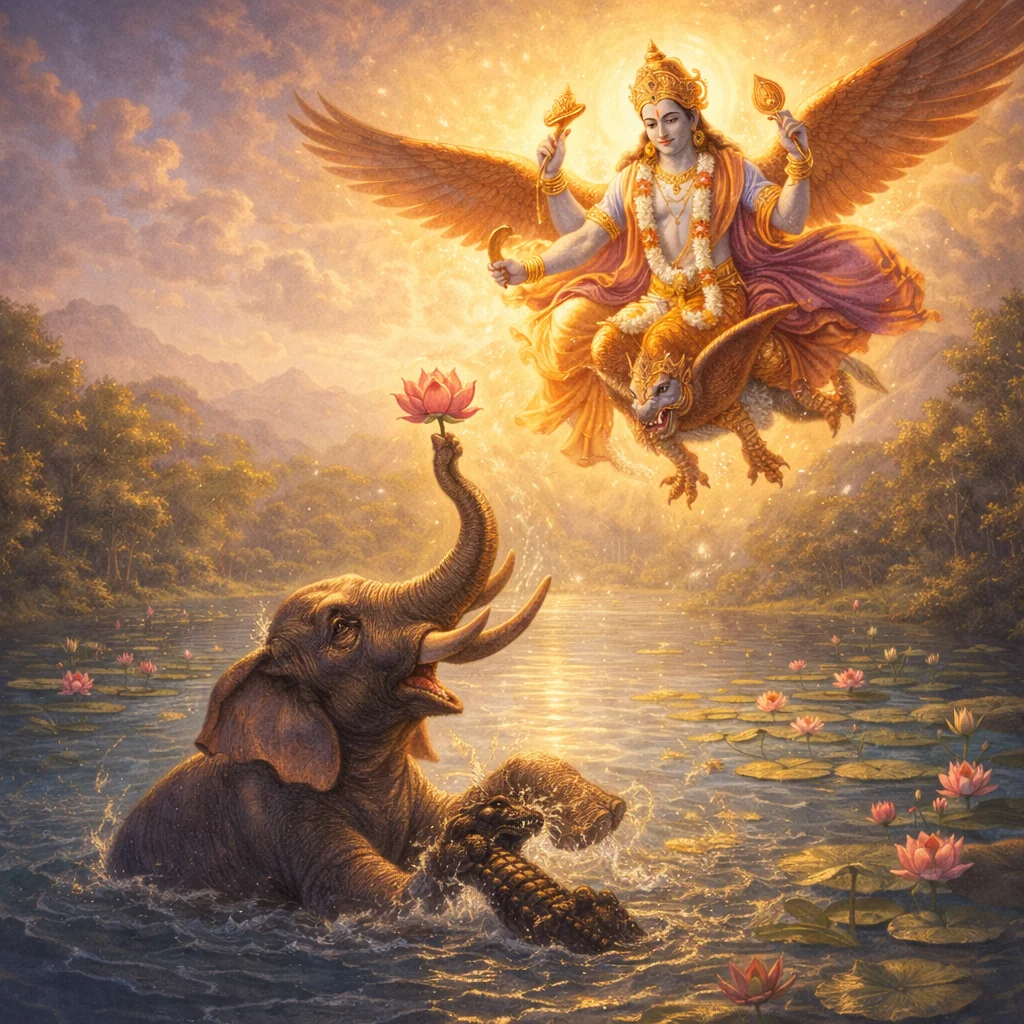
Gajendra, the elephant king, enters a lake with his companions and is suddenly seized by a powerful crocodile. A long, exhausting struggle follows, and as Gajendra's strength fades, he realizes that no material power can save him. In that moment of complete helplessness, he turns inward and takes shelter of the Supreme Lord, remembering a prayer from his previous life and offering it directly to Nārāyaṇa, not to any demigod.
Hearing the sincere cry of surrender, the Supreme Personality of Godhead personally appears, seated on Garuḍa, and rescues Gajendra from the jaws of death. The Bhāgavatam then reveals the past identities behind this event and shows how the Lord's direct touch frees Gajendra from bondage and grants him divine deliverance.
Śāstra‑pramāṇa (scriptural anchors)
Śrīmad‑Bhāgavatam 8.2 — The Crisis
सरस्यवगाह्य क्रीडन् बभूव हृदि तापित: । tatraikadā gajapatiḥ saha gajair madotkaṭaḥ
sarasy avagāhya krīḍan babhūva hṛdi tāpitaḥ Translation: Once, the king of the elephants, intoxicated with pride, entered the lake with his herd to sport. But within his heart he became tormented (when seized by the crocodile).
Śrīmad‑Bhāgavatam 8.3 — The Surrender
चक्षुरुन्मीलितं येन तस्मै श्री‑गुरवे नम: ॥ ajñāna‑timirāndhasya jñānāñjana‑śalākayā
cakṣur unmīlitaṁ yena tasmai śrī‑gurave namaḥ Meaning: I offer my obeisances unto the spiritual master, who with the torchlight of knowledge has opened my eyes, which were blinded by the darkness of ignorance.
Śrīmad‑Bhāgavatam 8.3 — Gajendra's Prayer
त्वमेव बन्धुश्च सखा त्वमेव ।
त्वमेव विद्या द्रविणं त्वमेव
त्वमेव सर्वं मम देव‑देव ॥ tvam eva mātā ca pitā tvam eva
tvam eva bandhuś ca sakhā tvam eva
tvam eva vidyā draviṇaṁ tvam eva
tvam eva sarvaṁ mama deva‑deva Translation: You alone are my mother and father, You alone are my relative and friend. You alone are knowledge and wealth, You alone are my everything, O Lord of lords.
Śrīmad‑Bhāgavatam 8.4 — The Deliverance
गरुडोपरि सम्भूय प्रादुरासीत् सुधार्णवे । sa eva bhagavān sākṣād dhariṇā dharaṇīdharaḥ
garuḍopari sambhūya prādurāsīt sudhārṇave Translation: That same Supreme Personality of Godhead, the maintainer of the entire creation, riding on Garuḍa, suddenly appeared in the sky over the lake.
Tattva (Vaiṣṇava meaning)
Sevā today (practice)
त्वमेव बन्धुश्च सखा त्वमेव ।
त्वमेव विद्या द्रविणं त्वमेव
त्वमेव सर्वं मम देव‑देव ॥"
You alone are my mother and father, You alone are my relative and friend. You alone are knowledge and wealth, You alone are my everything, O Lord of lords. (Śrīmad‑Bhāgavatam 8.3.18)
About this page
This page presents a complete Śāstra‑mārga Darśanam of the eternal pastime Gajendra‑mokṣa‑līlā. It follows a fixed structure: visual darśanam → scriptural summary → śāstra verses → philosophical meaning → practical application. The content is sourced directly from śāstra and traditional commentaries to provide an authentic resource for contemplation.