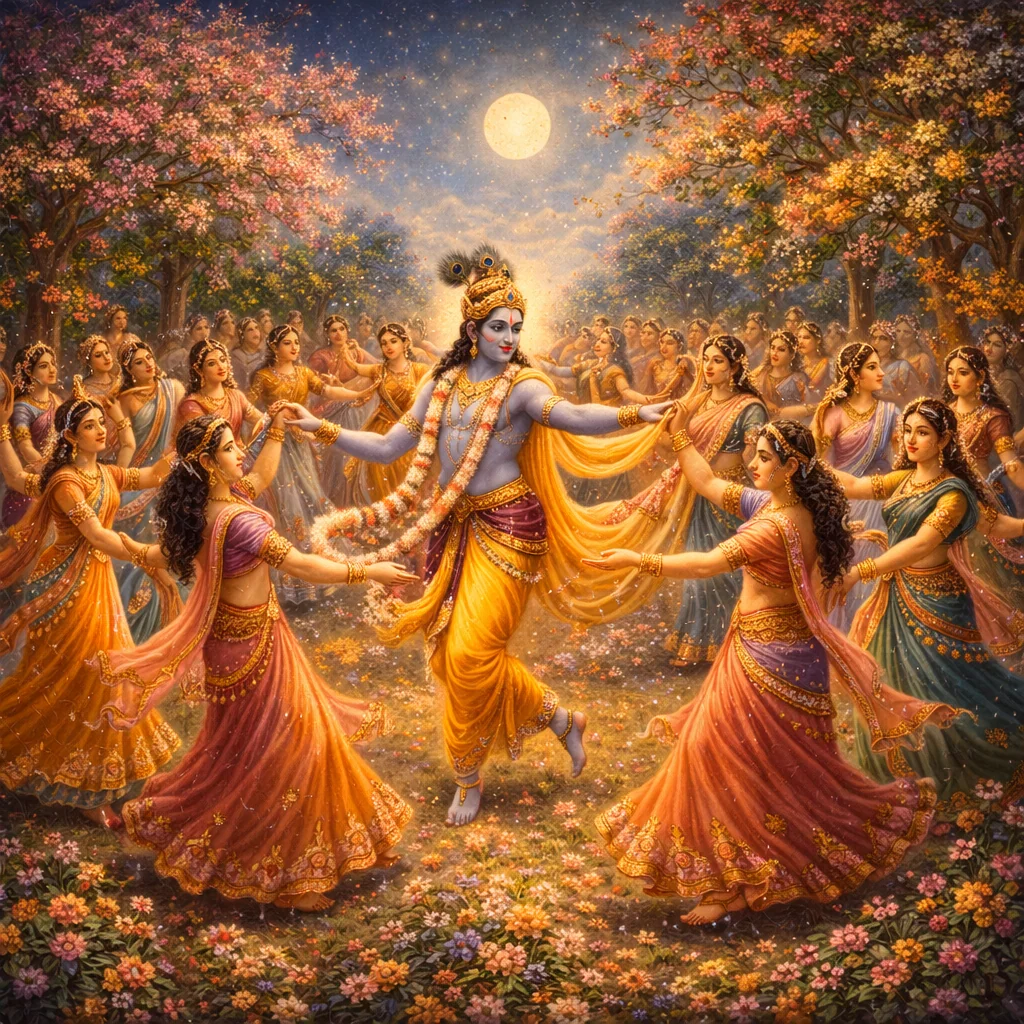
Saṅkṣepa (concise narration)
In the Vṛndāvana night, Śrī Kṛṣṇa plays His flute and calls the gopīs—His topmost devotees—drawing their hearts to Him alone. Leaving everything behind, they come to the forest, where Kṛṣṇa reveals the deepest truth of bhakti: pure love is not selfish desire, but complete surrender to the Lord’s pleasure.
In rāsa‑līlā, Kṛṣṇa expands Himself to reciprocate with each devotee, showing that the Supreme Person is fully personal and fully present with every surrendered heart. This līlā also teaches humility: when devotion is mixed with pride, Kṛṣṇa may withdraw to purify love, and sincere seeking brings His mercy again.
Śāstra‑pramāṇa (scriptural anchors)
Śrīmad‑Bhāgavatam 10.29 — The flute‑call and the gopīs’ response
गोप्य: कृष्णं स्मरन्त्यस्ता न शेकुर्व्याकुलेन्द्रियाः ॥ śrutvā veṇu‑ravaṁ tāsāṁ hṛdayāni drutaṁ yayuḥ
gopyaḥ kṛṣṇaṁ smarantyastā na śekur vyākulendriyāḥ Translation: Hearing the sound of the flute, their hearts rushed to Kṛṣṇa. The gopīs, remembering Him, could not control their agitated senses.
Śrīmad‑Bhāgavatam 10.30 — The Lord’s disappearance and purification
गोपीभिरन्वितो राजन् ररास रमयन् मुदा ॥ evaṁ bahu‑vidhaiḥ kṛṣṇaḥ prema‑bhāvitayā girā
gopībhir anvito rājan rarāsa ramayan mudā Meaning: Thus, O King, Kṛṣṇa, accompanied by the gopīs whose speech was filled with love, began the rāsa dance, giving them great delight.
Śrīmad‑Bhāgavatam 10.31 — Gopī‑gīta (prayers in separation)
दर्शनं देहि न: कृष्ण त्वयि सर्वं प्रतिष्ठितम् ॥ hā nātha he ramānātha sakhe vrajajanapriya
darśanaṁ dehi naḥ kṛṣṇa tvayi sarvaṁ pratiṣṭhitam Translation: O Lord, O beloved of the Vrajavāsīs, O friend, please show Yourself to us. Everything is established in You alone, O Kṛṣṇa.
Śrīmad‑Bhāgavatam 10.33 — The rāsa‑dance and its meaning
तथा तथैव भगवान् प्रसीदत्यच्युत: प्रभु: ॥ yathā yathā hi puruṣaḥ kṛṣṇe bhaktiṁ karoty uta
tathā tathaiva bhagavān prasīdaty acyutaḥ prabhuḥ Translation: To whatever degree a person performs devotion to Kṛṣṇa, to that same degree the infallible Lord, the Supreme, becomes pleased.
Tattva (Vaiṣṇava meaning)
Sevā today (practice)
तथा तथैव भगवान् प्रसीदत्यच्युत: प्रभु: ॥"
To whatever degree a person performs devotion to Kṛṣṇa, to that same degree the infallible Lord, the Supreme, becomes pleased. (Śrīmad‑Bhāgavatam 10.33.39)
About this page
This page presents a complete Śāstra‑mārga Darśanam of the eternal pastime Rāsa‑līlā. It follows a fixed structure: visual darśanam → scriptural summary → śāstra verses → philosophical meaning → practical application. The content is sourced directly from śāstra and traditional commentaries to provide an authentic resource for contemplation.