Pramāṇa (Śāstra reference)
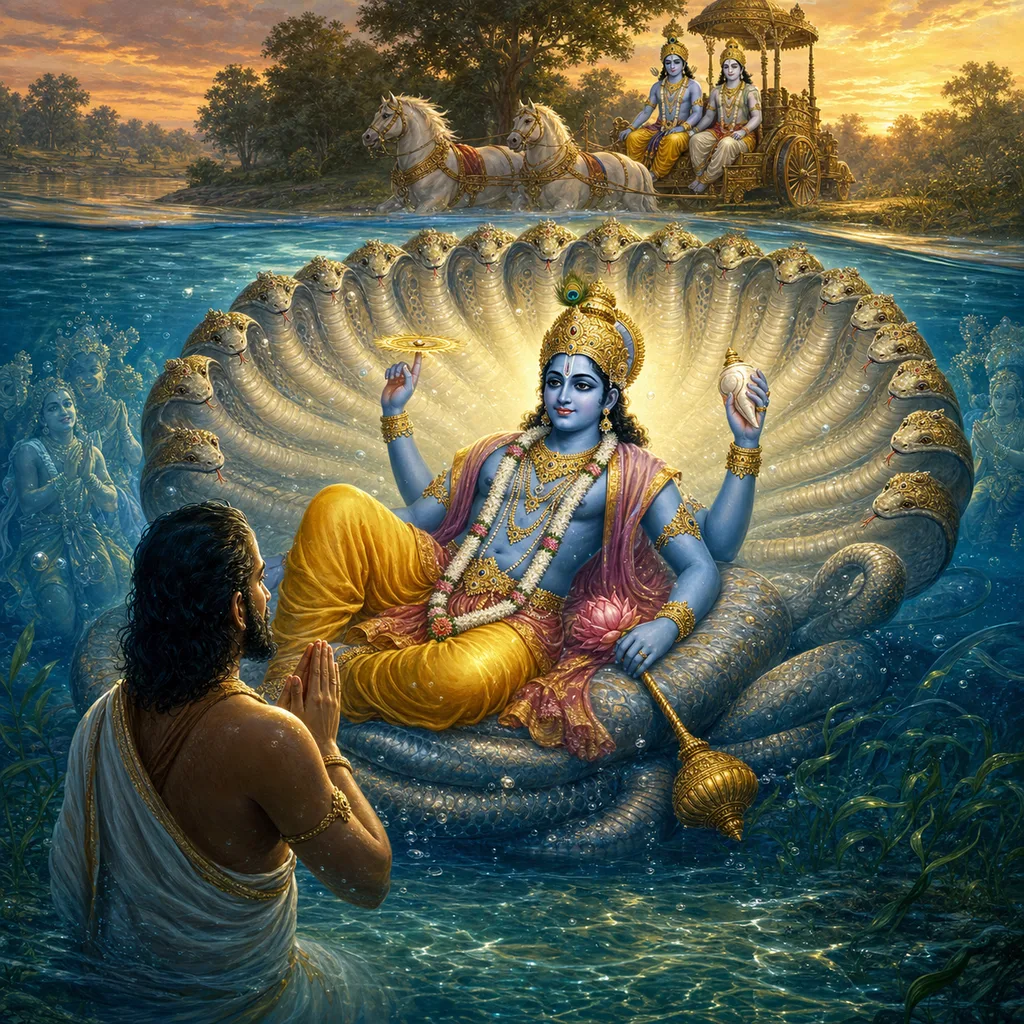
Śrīmad-Bhāgavatam 10.39.38–57 describes how Akrura stopped at the Yamuna while taking Krishna and Balarama to Mathura. After the two Lords had returned to the chariot, Akrura entered the river to bathe and recite Vedic mantras. He first saw Krishna and Balarama within the water, then returned to the chariot and found Them still seated there. Entering the water again, he beheld four-armed Lord Vasudeva, dark blue like a fresh raincloud and dressed in yellow, resting upon thousand-hooded Ananta Sesha. Surrounded by attendants, potencies and worshipers, the Lord received prayers. Akrura, filled with devotion, bowed his head, joined his palms and began to pray.
Saṅkṣepa (short meaning)
Akrura’s vision reveals that Krishna and Balarama are never limited by ordinary sight. The two Lords remain visibly seated on the chariot, yet within the Yamuna Akrura beholds the eternal Lord Vasudeva upon Ananta Sesha. The revelation does not arise from imagination: it is bestowed upon a devotee whose heart is absorbed in remembrance and service. Wonder becomes prayer, and knowledge becomes surrender.
Śāstra-pramāṇa (key points from the text)
The Lords remain on the chariot
(Śrīmad-Bhāgavatam 10.39.38–57)
Akrura sees Them in the water
(Śrīmad-Bhāgavatam 10.39.38–57)
He verifies the vision
(Śrīmad-Bhāgavatam 10.39.38–57)
Lord Vasudeva is revealed
(Śrīmad-Bhāgavatam 10.39.38–57)
Ananta Sesha serves the Lord
(Śrīmad-Bhāgavatam 10.39.38–57)
Vision becomes prayer
(Śrīmad-Bhāgavatam 10.39.38–57)
Tattva (essential teaching) — with śāstra
The Lord is unlimited
Revelation descends by grace
Balarama is Ananta Sesha
True seeing leads to surrender
Sevā today (practice for this day)
How to use this darśanam page
View the image, read the narration and śāstra-pramāṇa, contemplate the tattva, and complete the practice through seva. Follow the sequence: darśana → śravaṇa → manana → seva.