Pramāṇa (Śāstra reference)
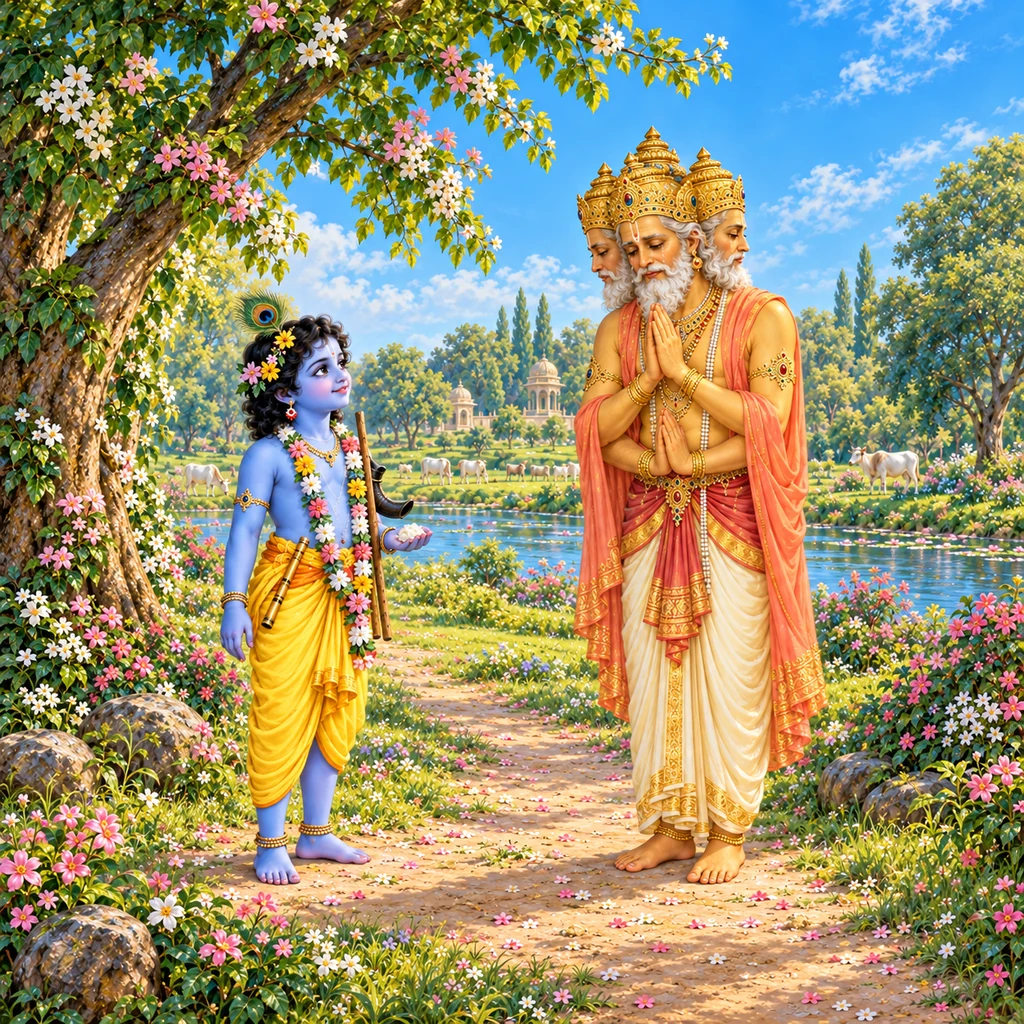
Śrīmad-Bhāgavatam 10.13.62–63 describes Brahmā descending from his swan carrier, prostrating before Kṛṣṇa and repeatedly bowing at His feet. The text mentions Brahmā’s golden complexion and four crowns. He then rises, wipes away his tears and begins his prayers with head bowed and hands joined (10.13.64). The illustration selects this moment after the obeisances. The first prayer describes Kṛṣṇa as Nanda’s son: His body resembles a raincloud, His garments shine like lightning, His face is adorned with guñjā earrings and a peacock feather, and He wears a forest garland (10.14.1). The BBT purport specifies rice mixed with yogurt in His left hand, a herding stick and buffalo horn beneath His left arm, and a flute tucked into His belt. Brahmā addresses the two-armed Kṛṣṇa appearing as a cowherd boy. Sunlight, flowers along the path and the composition are artistic choices.
Saṅkṣepa (short meaning)
After trying to test Kṛṣṇa, Brahmā is himself astonished by the Lord’s inconceivable power. Now he stands before Him with head bowed and hands joined. Before the universe’s creator is Nanda’s young son, wearing a peacock feather and holding a morsel of rice with yogurt. Brahmā offers prayers acknowledging Kṛṣṇa’s supremacy and the power of humble hearing about Him.
Śāstra-pramāṇa (key points from the text)
Brahmā bows at the Lord’s feet
(Śrīmad-Bhāgavatam 10.13.62–64; 10.14.1, 3, 8)
Wonder gives way to prayer
(Śrīmad-Bhāgavatam 10.13.62–64; 10.14.1, 3, 8)
He beholds Nanda’s son
(Śrīmad-Bhāgavatam 10.13.62–64; 10.14.1, 3, 8)
Humble hearing opens the way
(Śrīmad-Bhāgavatam 10.13.62–64; 10.14.1, 3, 8)
The devotee hopes for mercy
(Śrīmad-Bhāgavatam 10.13.62–64; 10.14.1, 3, 8)
Tattva (essential teaching) — with śāstra
Kṛṣṇa’s greatness shines through His sweetness
Brahmā’s position does not remove the need for humility
Hearing is devotional service
Hope for mercy sustains service
Sevā today (practice for this day)
How to use this darśanam page
View the image, read the narration and śāstra-pramāṇa, contemplate the tattva, and complete the practice through seva. Follow the sequence: darśana → śravaṇa → manana → seva.