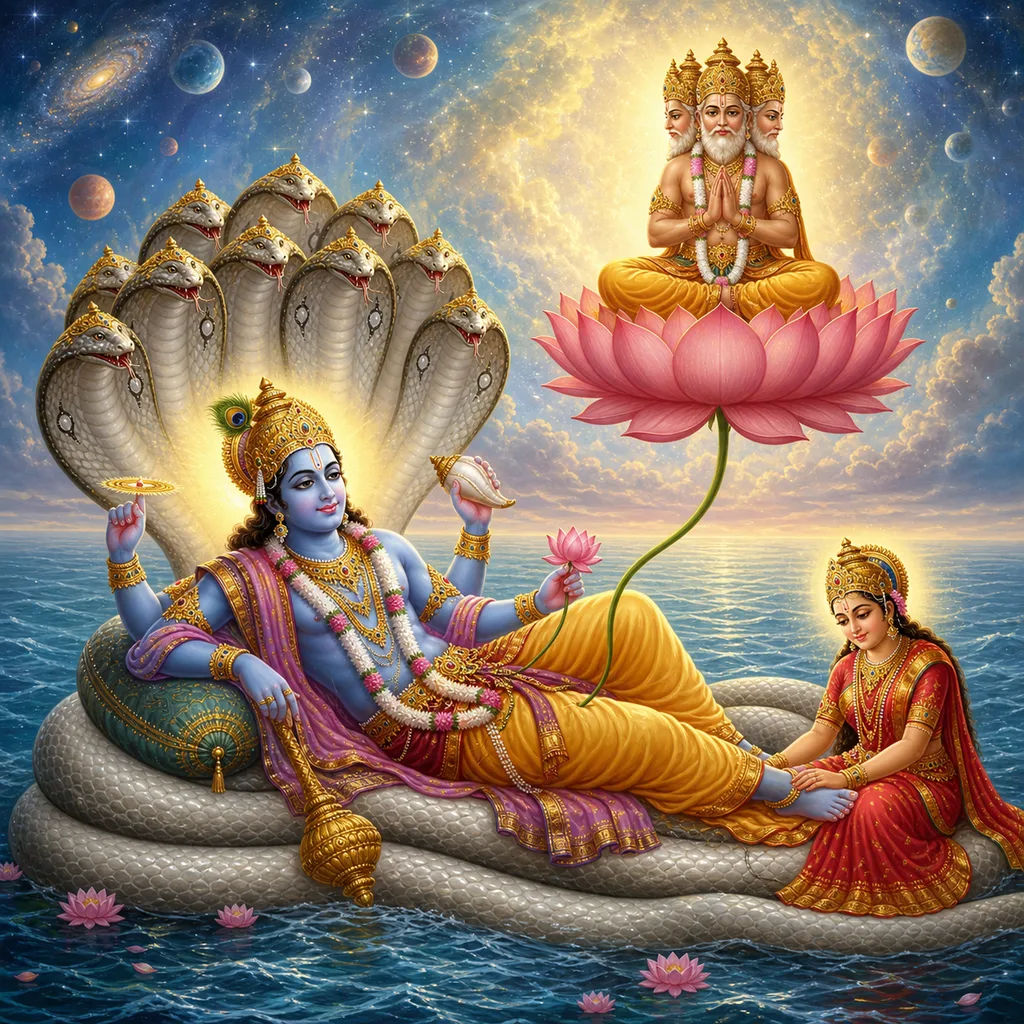
Pramāṇa (Śāstra reference)
Srimad-Bhagavatam, Canto 3, Chapter 9 describes how Lord Brahma, born upon the lotus from the navel of the Supreme Lord, performs meditation and austerity before beginning the work of creation. By the Lord’s mercy, Brahma beholds the Supreme Personality of Godhead and offers prayers filled with humility, dependence, and realization. Although Brahma is empowered to create the universe, he understands that his intelligence, power, and duty all come from the Lord.
Saṅkṣepa (short meaning)
This lila reveals the proper mood of spiritual responsibility. Brahma is not an ordinary being; he is the first created person in the universe and receives the task of secondary creation. Yet at the beginning of his service he does not act independently or proudly. He turns toward the Supreme Lord, offers prayers, and seeks the mercy by which his service can be properly performed. The scene teaches that real ability begins with surrender. Even the cosmic creator must depend upon Bhagavan, and therefore every devotee should begin service, work, study, and speech by remembering the Lord as the source of all intelligence and strength.
Śāstra-pramāṇa (key points from the text)
Brahma appears on the lotus
(Śrīmad-Bhāgavatam, Canto 3, Chapter 9)
He cannot create by himself
(Śrīmad-Bhāgavatam, Canto 3, Chapter 9)
He performs meditation
(Śrīmad-Bhāgavatam, Canto 3, Chapter 9)
The Lord reveals Himself
(Śrīmad-Bhāgavatam, Canto 3, Chapter 9)
Brahma offers prayers
(Śrīmad-Bhāgavatam, Canto 3, Chapter 9)
He prays for empowerment
(Śrīmad-Bhāgavatam, Canto 3, Chapter 9)
Creation becomes service
(Śrīmad-Bhāgavatam, Canto 3, Chapter 9)
Tattva (essential teaching) — with śāstra
All power comes from the Lord
Humility protects service
Prayer precedes action
Creation is not separate from bhakti
Sevā today (practice for this day)
How to use this darśanam page
View the image, read the narration and śāstra-pramāṇa, contemplate the tattva, and complete the practice through seva. Follow the sequence: darśana → śravaṇa → manana → seva.