Pramāṇa (Śāstra reference)
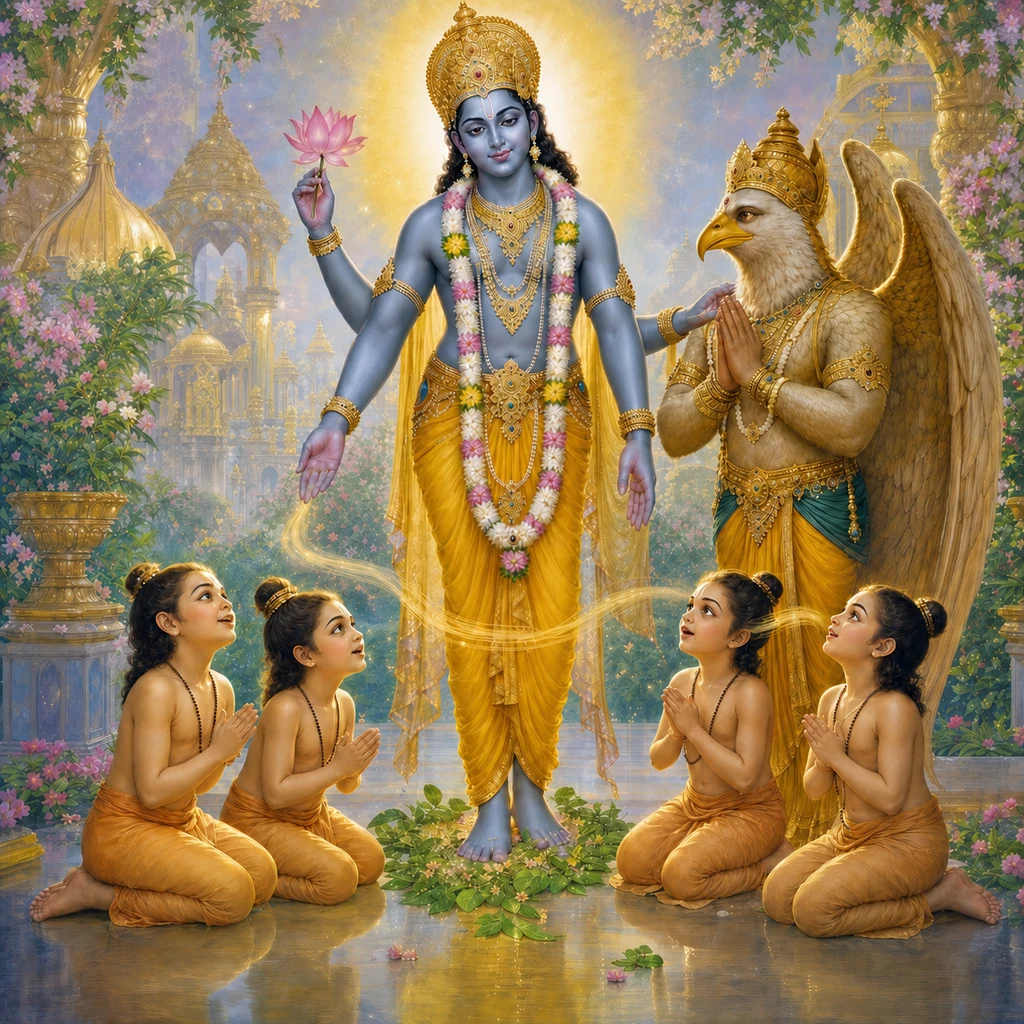
Śrīmad-Bhāgavatam 3.15.37–38 describes Lord Nārāyaṇa coming before the sages headed by Sanaka, accompanied by His associates, so that the Lord whom they had formerly seen in samādhi became visible to their eyes. His complexion was dark, His broad chest was the abode of the goddess of fortune, and His affectionate smile and glance touched the heart (3.15.39). He wore yellow cloth, a shining girdle and a fresh flower garland surrounded by humming bees. One hand rested on Garuḍa’s shoulder and another gracefully turned a lotus (3.15.40). A jeweled crown, makara-shaped earrings, a precious necklace, the Kaustubha gem and four strong arms adorned His transcendental form (3.15.41). The Kumāras joyfully bowed their heads at His lotus feet (3.15.42). Then the breeze carrying the aroma of tulasī leaves from the toes of those lotus feet entered their nostrils and produced a transformation in both mind and body, although they had been attached to impersonal Brahman realization (3.15.43). Looking repeatedly at the Lord’s beautiful face and ruby-like toenails, they attained meditation upon His personal form (3.15.44).
Saṅkṣepa (short meaning)
The four Kumāras had realized impersonal Brahman, yet the fragrance of tulasī offered at Nārāyaṇa’s lotus feet awakened a transformation beyond impersonal understanding. The Lord’s personal beauty, His devotees’ offering and the humble act of bowing opened their hearts to personal devotion.
Śāstra-pramāṇa (key points from the text)
Nārāyaṇa comes before the sages
(Śrīmad-Bhāgavatam 3.15.37–44)
The Lord reveals His personal beauty
(Śrīmad-Bhāgavatam 3.15.37–44)
The Kumāras bow at His feet
(Śrīmad-Bhāgavatam 3.15.37–44)
The tulasī fragrance reaches them
(Śrīmad-Bhāgavatam 3.15.37–44)
Their minds and bodies are transformed
(Śrīmad-Bhāgavatam 3.15.37–44)
Tattva (essential teaching) — with śāstra
The Supreme Truth has a personal form
Tulasī serves the Lord’s lotus feet
Bhakti engages the senses
Grace can deepen realization
Sevā today (practice for this day)
How to use this darśanam page
View the image, read the narration and śāstra-pramāṇa, contemplate the tattva, and complete the practice through seva. Follow the sequence: darśana → śravaṇa → manana → seva.