Śāstra‑mārga Darśanam — daily lila contemplation

LIVE DARSHAN & DAILY PRACTICE

A śāstra‑mārga darśanam page: image + śāstra pramāṇa + practice.

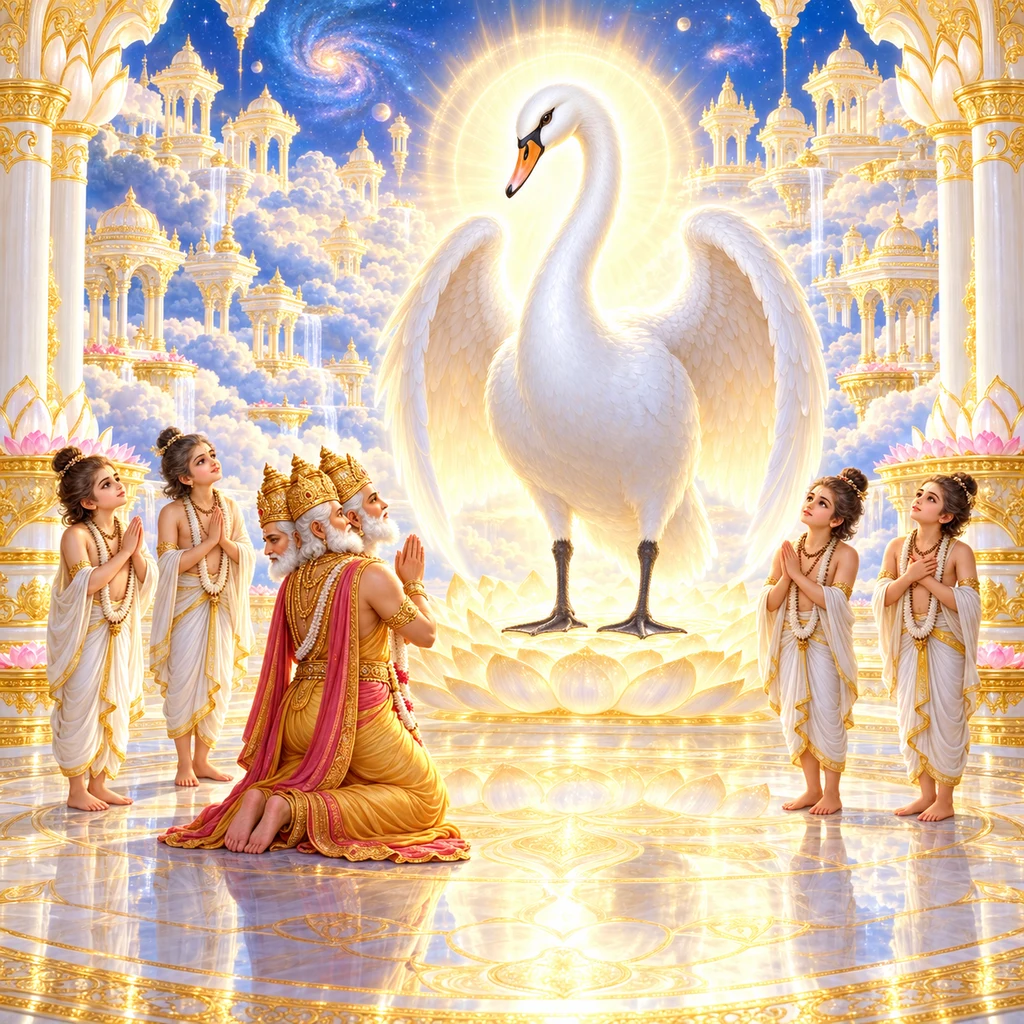
Haṁsa-avatāra appears before Brahmā and the four Kumāras

Haṁsa-avatāra appears before Brahmā and the four Kumāras
Appearance of Haṁsa-avatāra ŚB 11.13.16–42
Haṁsa-avatāra appears before Brahmā and the four Kumāras

Pramāṇa (Śāstra reference)

In ŚB 11.13.16–17 Sanaka and his brothers ask Brahmā a subtle question: how can one seeking liberation break the mutual bond between the mind and sense objects? In 11.13.18 Brahmā reflects deeply but, being absorbed in universal creation, cannot give a conclusive answer. In 11.13.19 he fixes his mind on the Supreme Lord, who becomes visible in His Haṁsa form. In 11.13.20–21 the sages place Brahmā at their head, approach, bow at the Lord’s lotus feet and ask Him their questions. In 11.13.22–40 Haṁsa explains the soul’s distinction from the body, mind and three states of material consciousness and teaches them to fix the mind on the Supreme Lord. In 11.13.41–42 the Kumāras’ doubts are dispelled; they worship and glorify the Lord before He returns to His abode. The illustration shows the appearance and worship described in verses 19–20. The white-and-gold surroundings, architecture, clothing and arrangement of the participants are artistic presentation; the Haṁsa form, Brahmā and the four Kumāras, their approach and worship follow the chapter directly.

Saṅkṣepa (short meaning)

Unable to resolve the four Kumāras’ subtle question, Brahmā fixes his mind on the Supreme Lord. The Lord appears in His Haṁsa form, accepts their worship and reveals the highest goal of yoga.

Śāstra-pramāṇa (key events from the text)

The four Kumāras ask a subtle question
Sanaka and his brothers ask Brahmā how to break the mutual bond between the mind and sense objects and attain the highest goal of yoga (11.13.16–17).
(Śrīmad-Bhāgavatam 11.13.16–42)
Brahmā seeks the answer from the Lord
Unable to reach a conclusive answer by reflection, Brahmā fixes his mind on the Supreme Lord (11.13.18–19).
(Śrīmad-Bhāgavatam 11.13.16–42)
The Lord becomes visible as Haṁsa
In response to Brahmā’s meditation, the Supreme Lord appears before him in His Haṁsa form (11.13.19).
(Śrīmad-Bhāgavatam 11.13.16–42)
The sages approach and worship
Placing Brahmā at their head, the four Kumāras bow at the Lord’s lotus feet and ask Him their questions (11.13.20–21).
(Śrīmad-Bhāgavatam 11.13.16–42)
The soul transcends the states of the material mind
Haṁsa explains that the soul is distinct from the mind, sense objects, waking, dreaming and deep sleep and should take shelter of the Supreme (11.13.24–33).
(Śrīmad-Bhāgavatam 11.13.16–42)
Doubts are dispelled through service
After hearing the teaching, the Kumāras become free from doubt and worship the Lord with beautiful hymns (11.13.38–42).
(Śrīmad-Bhāgavatam 11.13.16–42)

Tattva (essential teachings) — with śāstra

Perfect knowledge descends from the Supreme Lord
Brahmā turns to the Lord, and the Lord personally appears to answer a sincere spiritual question (11.13.18–21).

Śrīmad-Bhāgavatam 11.13.16–42

The soul is not the mind or its sense objects
The mind and sense objects are external coverings of the soul, which remains their witness (11.13.25–28).

Śrīmad-Bhāgavatam 11.13.16–42

The Lord is the basis of all perception
Haṁsa teaches that all perceived reality rests in Him and that He is the supreme shelter of knowledge, yoga and dharma (11.13.24, 38–40).

Śrīmad-Bhāgavatam 11.13.16–42

Fixing the mind on the Lord brings freedom
The living being transcends material states of consciousness by ceasing to identify with them and absorbing the mind in the Lord (11.13.28–33).

Śrīmad-Bhāgavatam 11.13.16–42

True understanding culminates in worship
Knowledge does not make the Kumāras proud: their doubts disappear, and they lovingly worship the Lord (11.13.41–42).

Śrīmad-Bhāgavatam 11.13.16–42

Sevā today (practice for this day)

1. Pray for spiritual discernment
Before japa, ask the Lord to help you distinguish the eternal soul and service to Him from the mind’s temporary movements.
2. Return your attention to the Holy Name
Notice one distraction without identifying with it, and gently return to hearing each Name attentively.
3. Read Haṁsa’s teaching
Read ŚB 11.13.16–42, giving special attention to verses 19–20, 24–28 and 38–42.
At that time, in My form of Haṁsa, I became visible to Lord Brahmā.
— Śrīmad-Bhāgavatam 11.13.19

How to use this darśanam page

View the image, read the narration and śāstra-pramāṇa, contemplate the tattva, and complete the meditation through service. Follow the sequence: darśana → śravaṇa → manana → seva.