Pramāṇa (Śāstra reference)
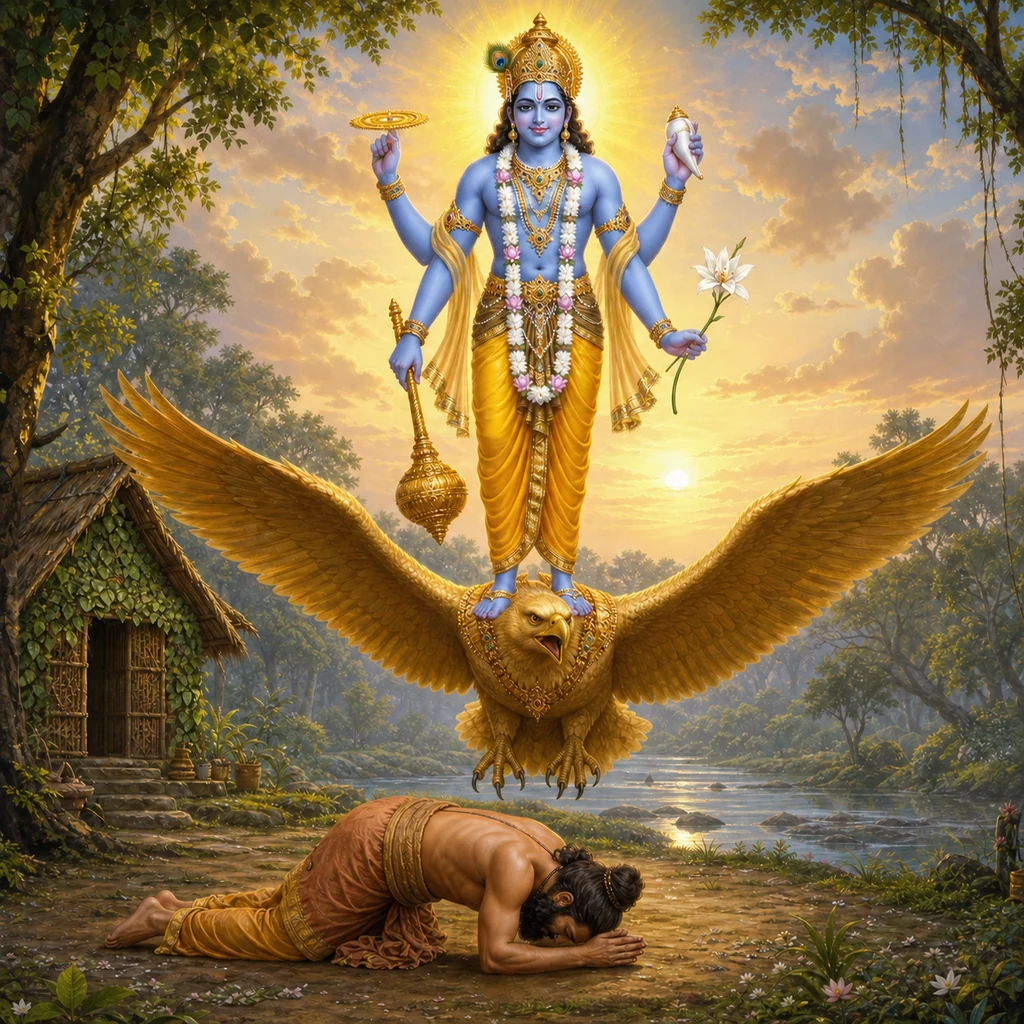
Śrīmad-Bhāgavatam 3.21.6–7 states that, obeying Lord Brahmā’s order, Kardama Muni performed austerities for ten thousand years on the bank of the Sarasvatī and worshiped the Supreme Lord through devotional service in trance. Pleased with him, the lotus-eyed Lord personally revealed His eternal transcendental form (3.21.8). Verses 9–11 describe the Lord as radiant like the sun, dressed in spotless yellow silk, with dark curling hair, crown and earrings, a garland of white lotuses and water lilies, the Kaustubha gem and a golden mark upon His chest. In His four hands He held a conch, disc, mace and white lily. Smiling joyfully, He stood in the air with His lotus feet upon Garuḍa’s shoulders. Seeing the Lord face to face, Kardama’s desire was fulfilled; he fell to the ground, bowed his head and offered prayers with folded hands and a heart full of love (3.21.12–13).
Saṅkṣepa (short meaning)
Kardama’s perfection was not an impersonal void but the personal darśana of the Lord whose form is described by śāstra. His long discipline became fruitful through devotional service, and the Lord answered it with presence, compassion and instruction. Kardama’s immediate response was gratitude and surrender.
Śāstra-pramāṇa (key points from the text)
Kardama obeys Brahmā
(Śrīmad-Bhāgavatam 3.21.6–13)
He worships through devotional trance
(Śrīmad-Bhāgavatam 3.21.6–13)
Lord Viṣṇu appears upon Garuḍa
(Śrīmad-Bhāgavatam 3.21.6–13)
Kardama falls in obeisance
(Śrīmad-Bhāgavatam 3.21.6–13)
The Lord answers His devotee
(Śrīmad-Bhāgavatam 3.21.6–13)
Tattva (essential teaching) — with śāstra
The perfection of yoga is personal
The Lord’s form is revealed by śāstra
Devotion gives austerity its purpose
Darśana awakens surrender
Sevā today (practice for this day)
How to use this darśanam page
View the image, read the narration and śāstra-pramāṇa, contemplate the tattva, and complete the practice through seva. Follow the sequence: darśana → śravaṇa → manana → seva.