Pramāṇa (Śāstra reference)
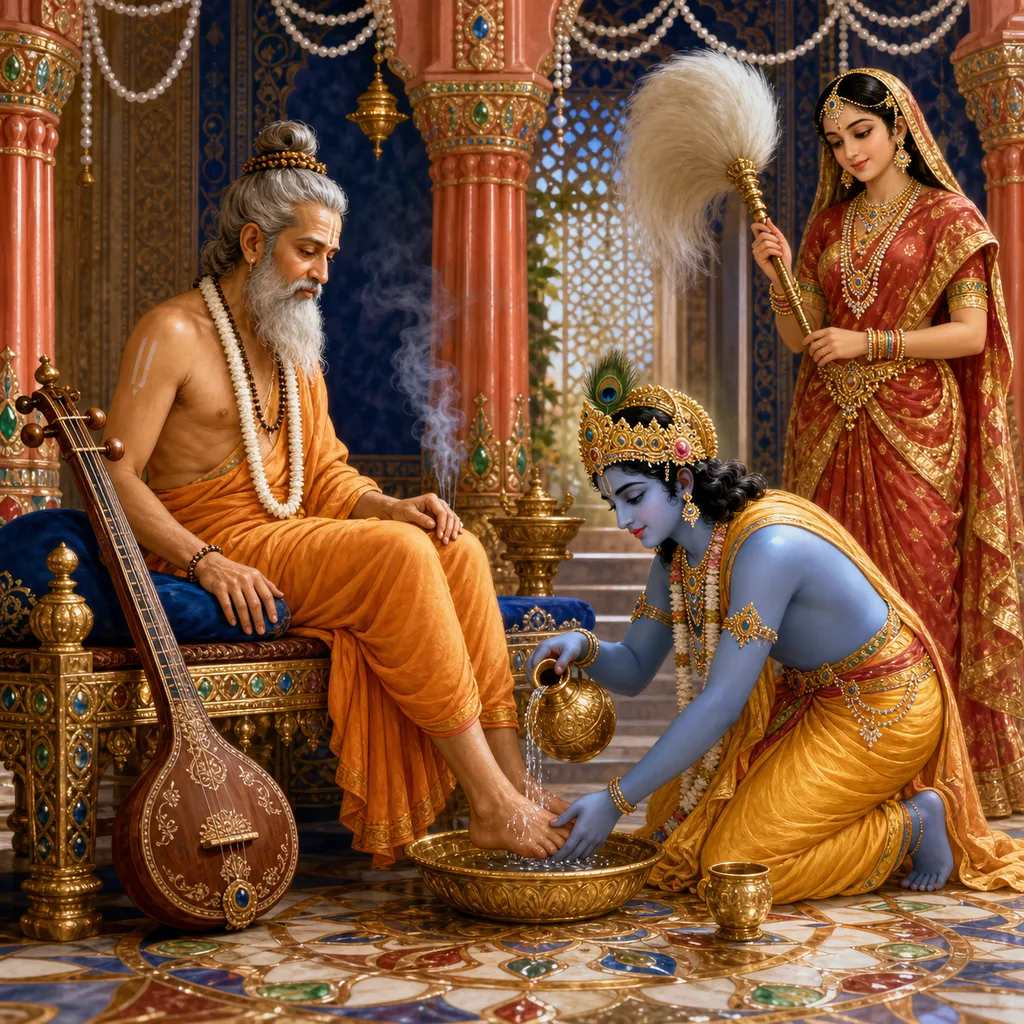
Śrīmad-Bhāgavatam 10.69 describes how Nārada Muni came to Dvārakā to witness Lord Krishna’s inconceivable household pastimes. Entering one magnificent palace, he saw Queen Rukmiṇī personally serving the Lord. Verses 13–14 state that Krishna immediately rose, bowed His crowned head at Nārada’s feet, seated the sage upon His own seat and worshiped him according to scriptural rule. Verse 15 says that the Lord washed Nārada’s feet and placed that water upon His own head. Although Krishna is the supreme spiritual master and His own foot-water becomes the Ganges, He acted as Brahmaṇya-deva, the Lord who favors the brāhmaṇas, to teach everyone how saintly persons should be honored. Nārada then prayed only to remember the Lord’s lotus feet wherever he traveled.
Saṅkṣepa (short meaning)
The scene reverses ordinary expectations: the Supreme Lord kneels before His devotee. Krishna needs no purification, yet He accepts the role of an exemplary householder and makes respect visible through personal service. Nārada’s response is equally instructive—he does not turn the Lord’s hospitality into a claim for privilege, but asks only for unbroken remembrance of Krishna’s lotus feet.
Śāstra-pramāṇa (key points from the text)
Nārada enters Rukmiṇī’s palace
(Śrīmad-Bhāgavatam 10.69.13–18)
Krishna rises immediately
(Śrīmad-Bhāgavatam 10.69.13–18)
The guest receives the Lord’s own seat
(Śrīmad-Bhāgavatam 10.69.13–18)
The Lord washes Nārada’s feet
(Śrīmad-Bhāgavatam 10.69.13–18)
Brahmaṇya-deva teaches by example
(Śrīmad-Bhāgavatam 10.69.13–18)
Nārada asks for remembrance
(Śrīmad-Bhāgavatam 10.69.13–18)
Tattva (essential teaching) — with śāstra
Supremacy and humility are harmonious
Hospitality is embodied respect
The Lord teaches through conduct
Remembrance is the devotee’s treasure
Sevā today (practice for this day)
How to use this darśanam page
View the image, read the narration and śāstra-pramāṇa, contemplate the tattva, and complete the practice through seva. Follow the sequence: darśana → śravaṇa → manana → seva.