Pramāṇa (Śāstra reference)
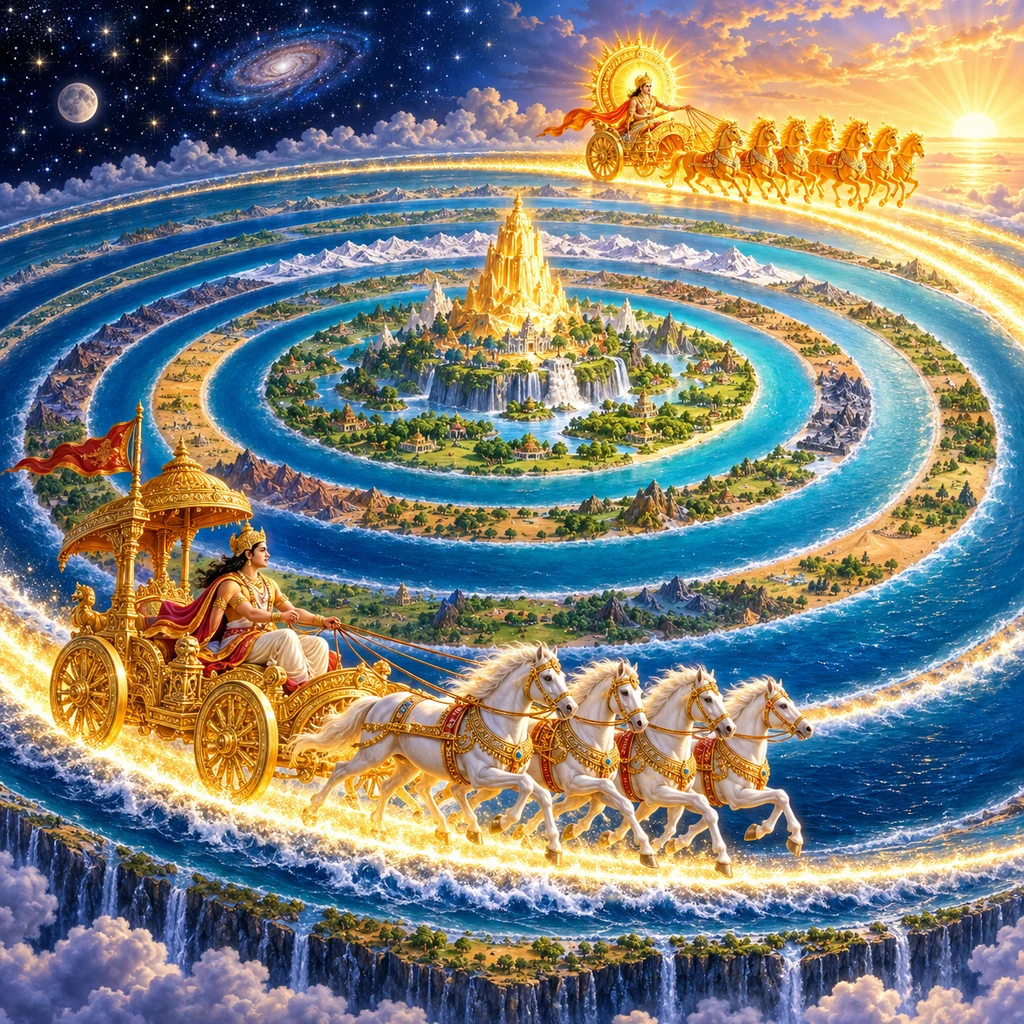
In ŚB 5.1.30, Mahārāja Priyavrata, dissatisfied that one side of the universe remains dark, follows the sun-god on his own brilliant chariot and makes night as bright as day. He performs this feat through the power attained by worshiping the Supreme Personality of Godhead. In 5.1.31 the impressions made by his chariot wheels become seven oceans dividing Bhū-maṇḍala into seven islands. ŚB 5.1.32 names Jambū, Plakṣa, Śālmali, Kuśa, Krauñca, Śāka and Puṣkara, and 5.1.33 describes their surrounding oceans and Priyavrata’s appointment of his sons as rulers. Priyavrata, the brilliant chariot, his following the Sun, Sumeru, and the seven circular oceans and islands come directly from the text. The appearance of the chariots and horses, island architecture, ocean colors, starry heavens and exact perspective are artistic presentation and are not offered as a literal cosmographic diagram.
Saṅkṣepa (short meaning)
Mahārāja Priyavrata sees that as the Sun travels, part of the universe remains dark. Through the power attained by worshiping the Lord, he follows the Sun on a brilliant chariot and illuminates the night. Seven furrows made by his chariot wheels become seven oceans dividing Bhū-maṇḍala into seven islands.
Śāstra-pramāṇa (key events from the text)
Priyavrata notices the unequal light
(Śrīmad-Bhāgavatam 5.1.30)
Power comes through worship of the Lord
(Śrīmad-Bhāgavatam 5.1.30)
A brilliant chariot follows the Sun
(Śrīmad-Bhāgavatam 5.1.30)
Wheel tracks become oceans
(Śrīmad-Bhāgavatam 5.1.31)
Bhū-maṇḍala is divided into seven islands
(Śrīmad-Bhāgavatam 5.1.32)
Priyavrata entrusts rule to his sons
(Śrīmad-Bhāgavatam 5.1.33)
Tattva (essential teachings) — with śāstra
Devotional service opens the impossible
A devotee’s strength is used for others
Service joins resolve with responsibility
Cosmic grandeur remains under the Lord
A ruler knows how to entrust service
Sevā today (practice for this day)
How to use this darśanam page
View the image, read the narration and śāstra-pramāṇa, contemplate the tattva, and complete the meditation through service. Follow the sequence: darśana → śravaṇa → manana → seva.