Pramāṇa (Śāstra reference)
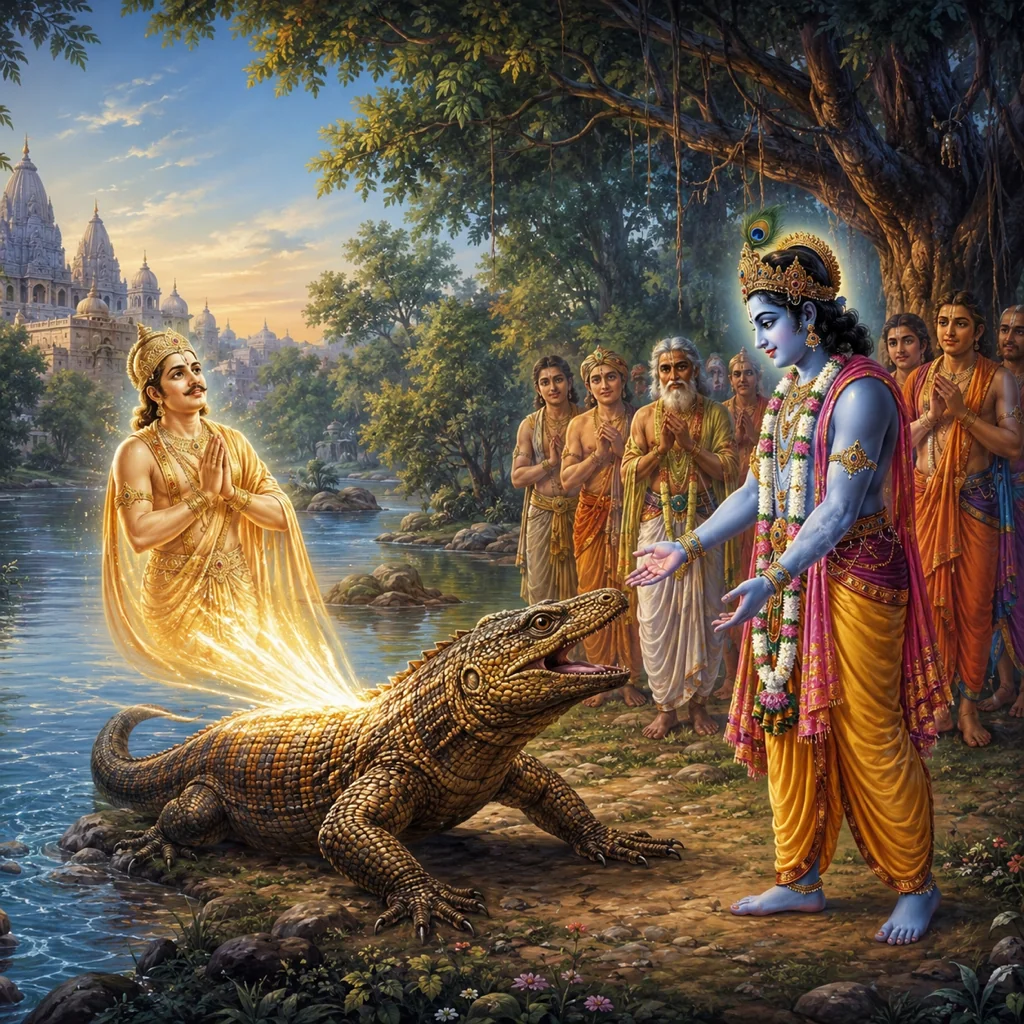
Śrīmad-Bhāgavatam, Canto 10, Chapter 64 — the young Yadus discover a huge lizard trapped in a dry well. Unable to rescue it, they call Lord Krishna, who easily lifts the creature out with His left hand. By the touch of the Lord’s hand, the lizard at once gives up that form and appears as the celestial King Nriga.
Saṅkṣepa (short meaning)
This lila reveals both the Lord’s compassion and the subtle seriousness of dharma. King Nriga had been extraordinarily charitable, yet because of an error involving a brahmana’s cow he fell into the body of a lizard. Still, because he had maintained devotion and longed for the Lord’s audience, he was ultimately delivered by Krishna’s touch. The lila teaches that even great piety does not cancel the laws of responsibility, yet the mercy of the Lord is supreme and can lift the soul beyond all bondage.
Śāstra-pramāṇa (key points from the text)
The Yadus find a lizard
(Śrīmad-Bhāgavatam, Canto 10, Chapter 64)
They cannot lift it out
(Śrīmad-Bhāgavatam, Canto 10, Chapter 64)
Krishna rescues the creature
(Śrīmad-Bhāgavatam, Canto 10, Chapter 64)
The touch of the Lord transforms him
(Śrīmad-Bhāgavatam, Canto 10, Chapter 64)
Nriga explains his fall
(Śrīmad-Bhāgavatam, Canto 10, Chapter 64)
Nriga departs after prayer
(Śrīmad-Bhāgavatam, Canto 10, Chapter 64)
Krishna instructs humanity
(Śrīmad-Bhāgavatam, Canto 10, Chapter 64)
Tattva (essential teaching) — with śāstra
Piety alone is not enough
Mercy does not erase moral truth
Contact with Krishna liberates
The Lord saves and instructs
Sevā today (practice for this day)
How to use this darśanam page
View the image, read the narration and śāstra-pramāṇa, contemplate the tattva, and complete the practice through seva. Follow the sequence: darśana → śravaṇa → manana → seva.