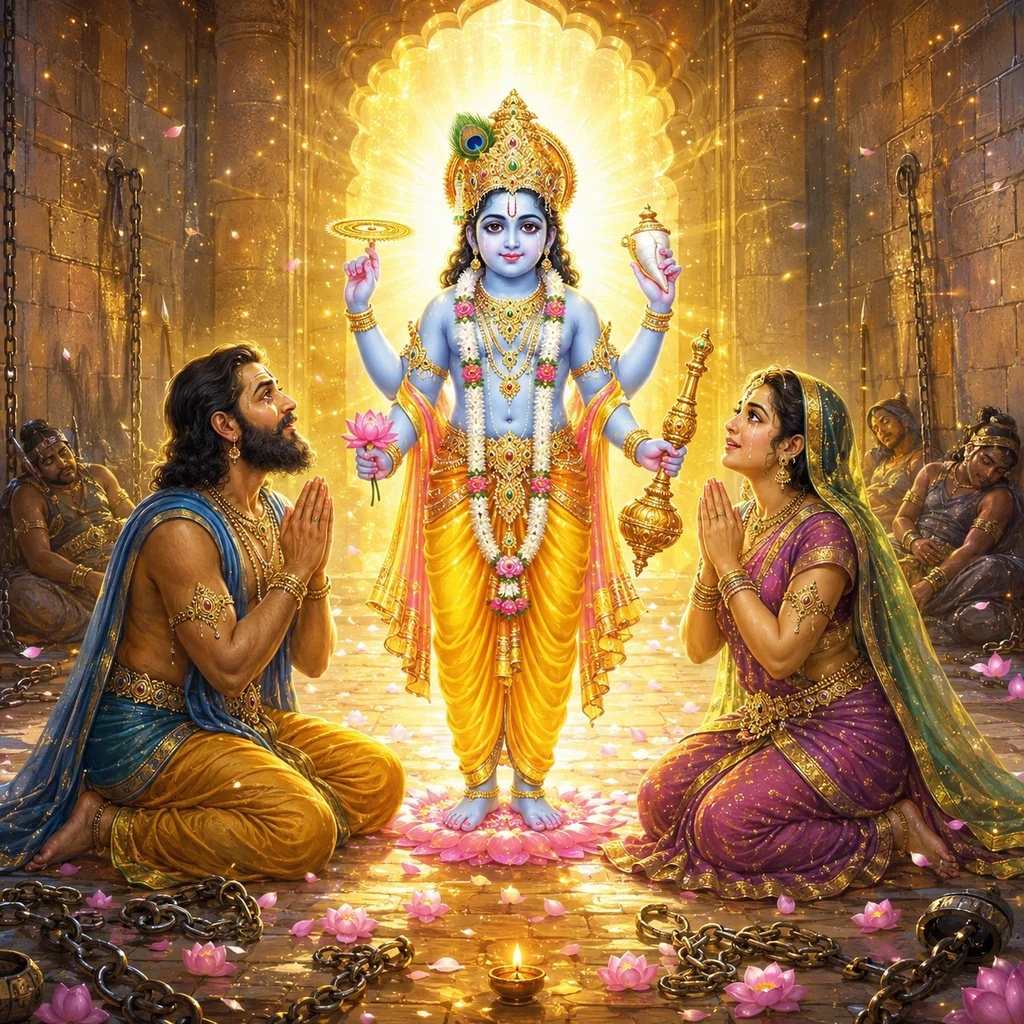
Pramāṇa (Śāstra reference)
Srimad-Bhagavatam, Canto 10, Chapter 3, describes the appearance of Lord Krishna in Kamsa’s prison. On the night of His appearance, Devaki and Vasudeva do not see an ordinary child. They behold the Supreme Personality of Godhead in a radiant four-armed form, bearing the conch, disc, mace and lotus. The Lord reveals that He appears for the protection of His devotees and the removal of demoniac oppression; then, at the request of His parents, He conceals His majestic form and appears as an infant.
Saṅkṣepa (short meaning)
Janmashtami reminds devotees that Krishna is not born under the force of matter. He appears by His own internal potency, accepting the love of His devotees and revealing the path of bhakti. Kamsa’s prison becomes a place of divine revelation: fear is overcome by darshan, chains lose their power, and the hearts of Devaki and Vasudeva become filled with awe and parental love. This lila teaches that the Lord can appear even in the midst of external restriction when the devotee holds faith, prayer and shelter.
Śāstra-pramāṇa (key points from the text)
Krishna appears in Kamsa’s prison
(Srimad-Bhagavatam 10.3)
The parents behold the four-armed form
(Srimad-Bhagavatam 10.3.9–10)
The Lord reveals the purpose of His appearance
(Srimad-Bhagavatam 10.3)
Vasudeva receives the instruction
(Srimad-Bhagavatam 10.3.47–49)
Tattva (essential teaching) — with śāstra
Krishna is not born like a conditioned soul
The Lord responds to the prayers of devotees
Majesty and sweetness meet
The festival leads to hearing and kirtana
Sevā today (practice for this day)
How to use this darśanam page
View the image, read the narration and śāstra-pramāṇa, contemplate the tattva, and complete the practice through seva. Follow the sequence: darśana → śravaṇa → manana → seva.