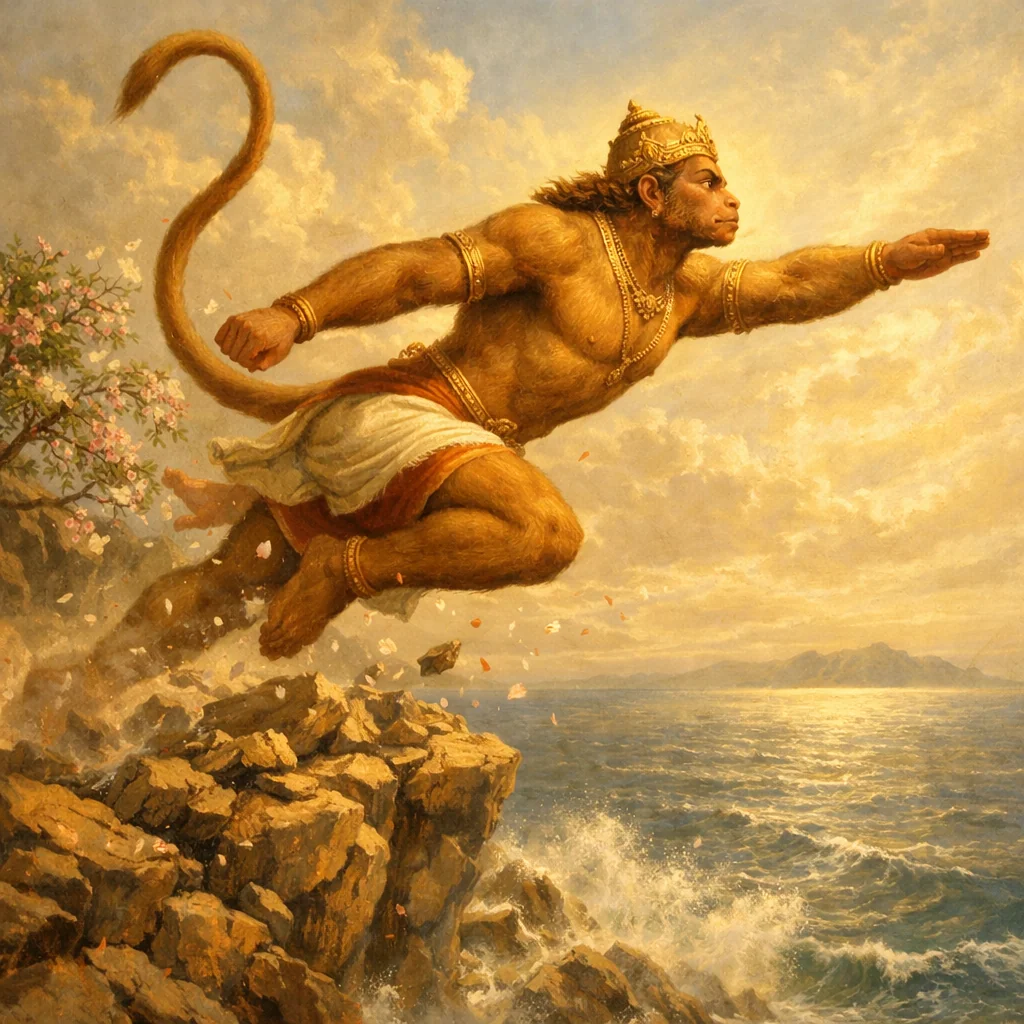
Saṅkṣepa (short meaning)
This lila reveals Hanuman as the perfect servant of the Lord. Standing on Mount Mahendra, fully gathered in mind, breath, strength, and purpose, Hanuman crosses the vast ocean not for fame, conquest, or self-display, but solely to fulfill Lord Rama’s order and find Sita Devi. His leap shows that what is impossible for ordinary strength becomes possible through bhakti, surrender, and one-pointed service to the Lord.
Pramāṇa: Vālmīki Rāmāyaṇa, Sundara-kāṇḍa, Sarga 1
Śāstra-pramāṇa (key points from the text)
Sundara-kāṇḍa, Sarga 1 — The great resolve
• He enlarges his form on Mount Mahendra and gathers his energy with complete concentration for Rama’s mission.
The leap — devotion in action
Hanuman crosses the immeasurable ocean in search of Sita Devi as the faithful messenger and servant of Lord Rama.
Śāstra reference — Vālmīki Rāmāyaṇa
— Sundara-kāṇḍa, 1.70–75 (paraphrased)
Tattva (essential teaching) — with śāstra
True strength is not independent heroism but power offered in service to the Lord. Hanuman acts only for Lord Rama’s pleasure and mission.
Bhakti gathers and purifies all faculties — mind, breath, intelligence, and bodily strength — into one-pointed service.
The ocean of impossibility is crossed when one acts under divine order, without selfish motive, and with full remembrance of the Lord.
Hanuman embodies servant-devotion: humility, obedience, courage, steadiness, intelligence, and complete dedication to the Lord’s purpose.
Sevā today (practice for this day)
prasādaṁ kurute tasmai tasmai dadyān manaḥ sadā”
Whatever is done, by whomever it is done, and for whom it is offered — one should always fix the mind on the Lord’s mercy and serve without expectation.
How to use this darśanam page
This page provides a complete śāstra‑mārga contemplation on Hanuman’s Great Leap to Lanka. Use it for daily meditation: View the image → read the narration → study the śāstra pramāṇa → contemplate the tattva → perform the seva. The structure is fixed to maintain śāstric integrity while allowing deep personal reflection.