Saṅkṣepa (concise narration)
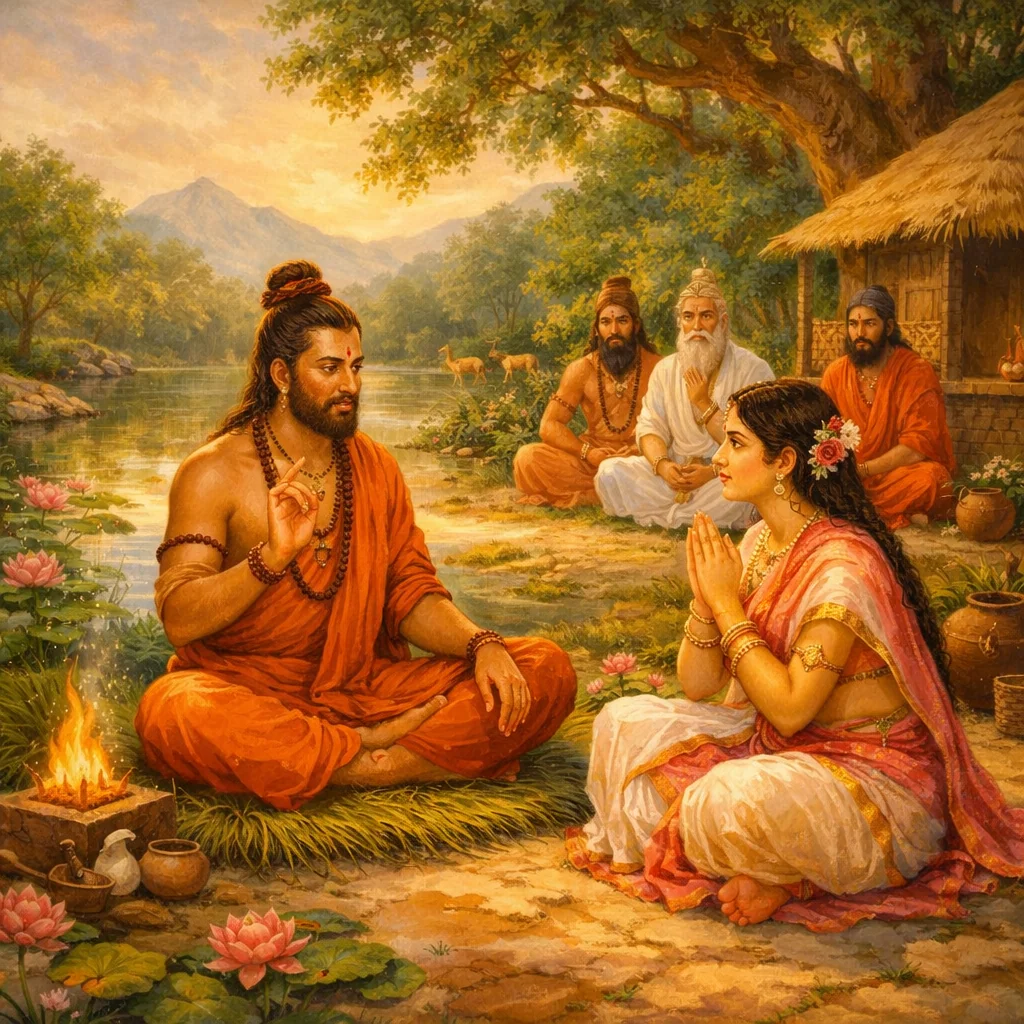
Devahūti approaches her divine son, Lord Kapila, with humility and sincere longing for spiritual realization. Seated in a peaceful āśrama setting, Kapila Muni instructs her on the nature of the soul, the bondage of material identification, and the pure path of devotional service that leads to liberation and love of God. This līlā reveals the Lord’s compassion: He personally teaches those who sincerely seek Him, and He establishes bhakti as the heart of true knowledge.
"The Lord teaches bhakti from within and without: He guides sincere seekers. True knowledge culminates in devotion: bhakti is the essence, not merely intellect. Humility opens the heart to revelation: Devahūti’s mood attracts mercy. Liberation is purified consciousness: freedom means awakening love for the Lord."
Devahūti respectfully approaches Kapila and asks for spiritual instruction. Kapila explains the soul’s relationship with matter and the process of liberation. He teaches the glories of devotional service as the purifying, liberating path.
Śāstra‑pramāṇa (scriptural proof)
Śrīmad-Bhāgavatam 3.25 — Devahūti’s inquiry
"My dear Lord, I have fallen into the darkness of ignorance. Please enlighten me with the torch of knowledge. I have taken shelter of Your lotus feet because You are the only person of whom I can ask for the remedy of my unbearable material pangs."
Translation: Devahūti surrenders to Lord Kapila and requests spiritual knowledge to dispel her ignorance.
Śrīmad-Bhāgavatam 3.28 — The path of bhakti
"Bhakti, devotional service, is the ultimate path for self-realization. By engaging in My transcendental service, one becomes purified of material contamination and gradually rises to the platform of love of Godhead."
Meaning: Lord Kapila explains that devotional service is the supreme means for purification and spiritual advancement.
Śrīmad-Bhāgavatam 3.29 — Liberation through devotion
"The Supreme Personality of Godhead is realized by the process of devotional service, and when He is realized, the knot of material attachment in the heart is severed, all misgivings are cut to pieces, and the chain of fruitive action is terminated."
Meaning: Through bhakti, one attains liberation by cutting the bonds of material attachment and karma.
Śrīmad-Bhāgavatam 3.33 — The result of hearing
"Thus hearing from the Lord, Devahūti became completely cleansed of the dirt of material contamination and achieved transcendental knowledge. She became fully absorbed in thought of the Supreme Personality of Godhead."
Meaning: By hearing Kapila’s teachings, Devahūti attained pure consciousness and fixed her mind on the Lord.
Tattva (what this lila teaches)
The Lord teaches bhakti from within and without: He guides sincere seekers both as the spiritual master and as the Supersoul.
True knowledge culminates in devotion: bhakti is the essence, not merely intellectual understanding.
Humility opens the heart to revelation: Devahūti’s mood of surrender attracts divine mercy.
Liberation is purified consciousness: freedom means awakening love for the Lord, not just release from material bondage.
Sevā today (simple practice)
1) Chant with focused prayer
Chant one focused round with the prayer: “Kapila, please grant me steady devotion and clear understanding.”
Read a small portion of Bhāgavatam today and offer the result to the Lord.
3) Practice humility
Do one act of humility—listen carefully, speak gently, and serve without seeking praise.
"The Supreme Lord said: My dear mother, the path of self-realization which I shall now describe to you is the same as I explained formerly to the great sage Sanat-kumāra. It is the supreme means of attaining the Absolute Truth."
Lord Kapila begins his teachings to Devahūti, establishing the authority and universality of the spiritual knowledge he imparts.
How to use this darśanam page
This page provides a complete śāstra‑mārga contemplation on the Kapila‑Devahūti‑upadeśa‑līlā. Use it for daily meditation:
View the image → read the narration → study the śāstra pramāṇa → contemplate the tattva → perform the seva.
The structure is fixed to maintain śāstric integrity while allowing deep personal reflection.