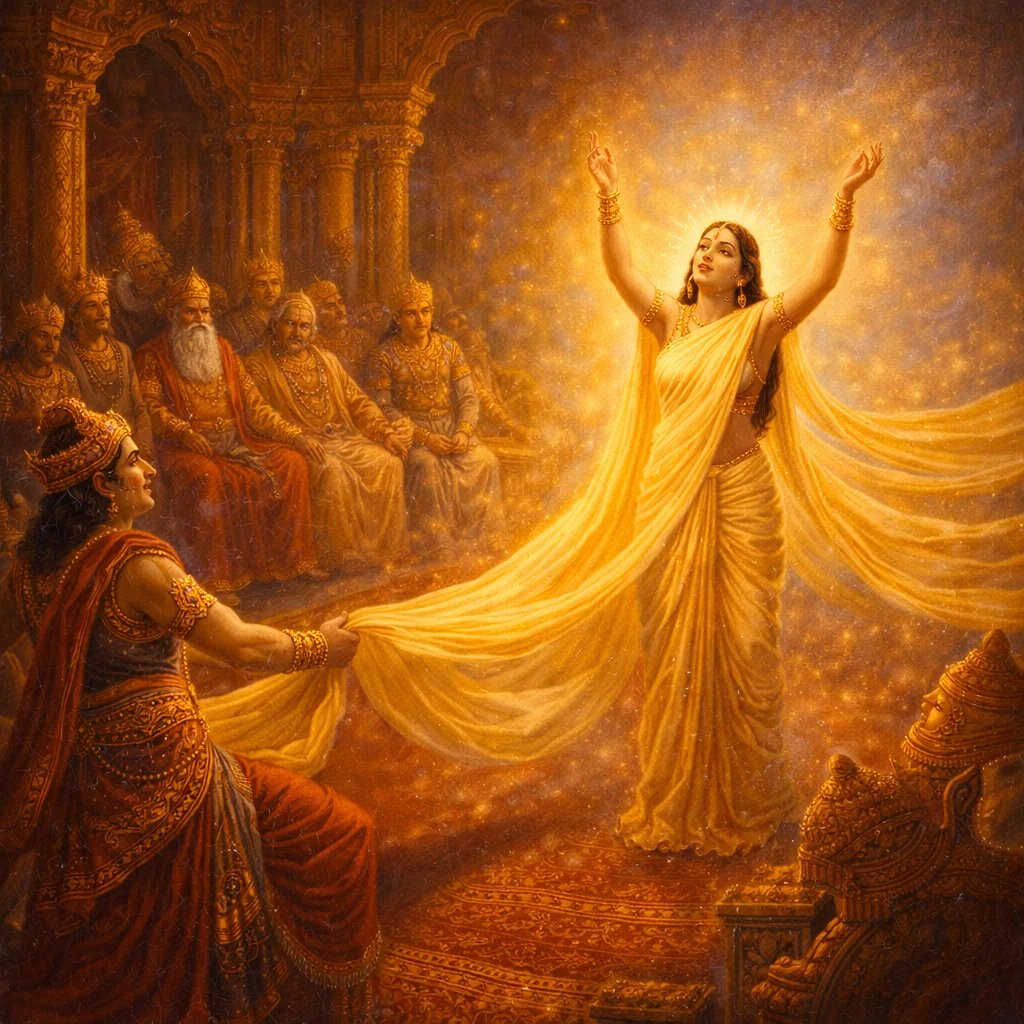
Saṅkṣepa (concise narration)
When dharma appears defeated and injustice is celebrated as “law,” the Lord shows that the devotee is never alone. In the royal assembly after the dice game, Draupadī is dragged into the sabhā and humiliated. When human strength, social status, and even elders’ voices fail to protect her, she takes full shelter of Śrī Kṛṣṇa. Hearing her surrendered call, the Lord manifests His protection: her honor is preserved by divine arrangement (akṣaya‑vāsa), and the offenders are stopped.
This līlā reveals the core of Vaiṣṇava teaching: real safety is not in circumstances, but in śaraṇāgati (surrender). The Lord may allow a devotee to be tested, yet He never abandons one who calls upon Him with faith. Draupadī‑rakṣā shows that Kṛṣṇa is the ultimate guardian of dignity, dharma, and the devotee’s heart.
ahaṁ tvā sarvapāpebhyo mokṣayiṣyāmi mā śucaḥ"
Abandon all varieties of religion and just surrender unto Me. I shall deliver you from all sinful reactions. Do not fear.
Śāstra‑pramāṇa (scriptural proof)
Mahābhārata — Sabhā‑parva (Dyūta‑līlā & Draupadī‑vastrāharaṇa)
Draupadī’s appeal for protection; the Lord’s intervention through akṣaya‑vāsa. Key event: When human justice failed, divine protection manifested. The Lord preserved Draupadī’s honor by providing endless cloth.
Śrīmad‑Bhāgavatam 1.8 — Kuntī‑devī’s prayers
tvam asya viśvasya paraṁ nidhānam
tvam avyayaḥ śāśvata‑dharma‑goptā
sanātanaḥ tvam puruṣo mato me" Translation: You are the supreme indestructible object of knowledge, the ultimate treasure of this universe. You are imperishable, the eternal protector of dharma, the ancient Personality of Godhead — that is my opinion.
Kuntī remembers how the Lord protected Draupadī in the crisis of the assembly, confirming the Lord’s personal guardianship of His devotees.
Śrīmad‑Bhāgavatam 1.9.16 — Bhīṣma’s testimony
abhyutthānam adharmasya tadātmānaṁ sṛjāmy aham" Meaning: Whenever and wherever there is a decline in religious practice and a predominant rise of irreligion — at that time I descend Myself.
The Draupadī‑rakṣā episode demonstrates this principle: when adharma reached its peak in the sabhā, the Lord personally intervened to protect dharma.
Mahābhārata — Udyoga‑parva (Kṛṣṇa’s assurance)
"My devotee never perishes." This fundamental promise is visually enacted in Draupadī‑rakṣā. The Lord’s protection is absolute when surrender is complete.
Tattva (essential teaching)
Śaraṇāgati is the turning point: when worldly supports collapse, pure shelter in Kṛṣṇa becomes visible and real.
The Lord protects dharma by protecting the devotee: dishonor of a surrendered devotee is never “just a social event”—it becomes the Lord’s concern.
Aparādha brings ruin: humiliation of a devotee (and exploitation of dharma) invites inevitable consequences.
Kṛṣṇa is bhakta‑vatsala: He responds to the devotee’s helpless call and preserves what is essential—faith, honor, and remembrance.
Sevā today (practice for this day)
oṁ namo bhagavate vāsudevāya
(or) oṁ namo bhagavate vāsudevāya govindāya namaḥ
sanātanaḥ tvam puruṣo mato me"
You are imperishable, the eternal protector of dharma, the ancient Personality of Godhead — that is my opinion.
How to use this darśanam page
This page provides a complete śāstra‑mārga contemplation on the Draupadī‑rakṣā līlā. Use it for daily meditation: View the image → read the narration → study the śāstra pramāṇa → contemplate the tattva → perform the seva. The structure is fixed to maintain śāstric integrity while allowing deep personal reflection.