Saṅkṣepa (concise narration)
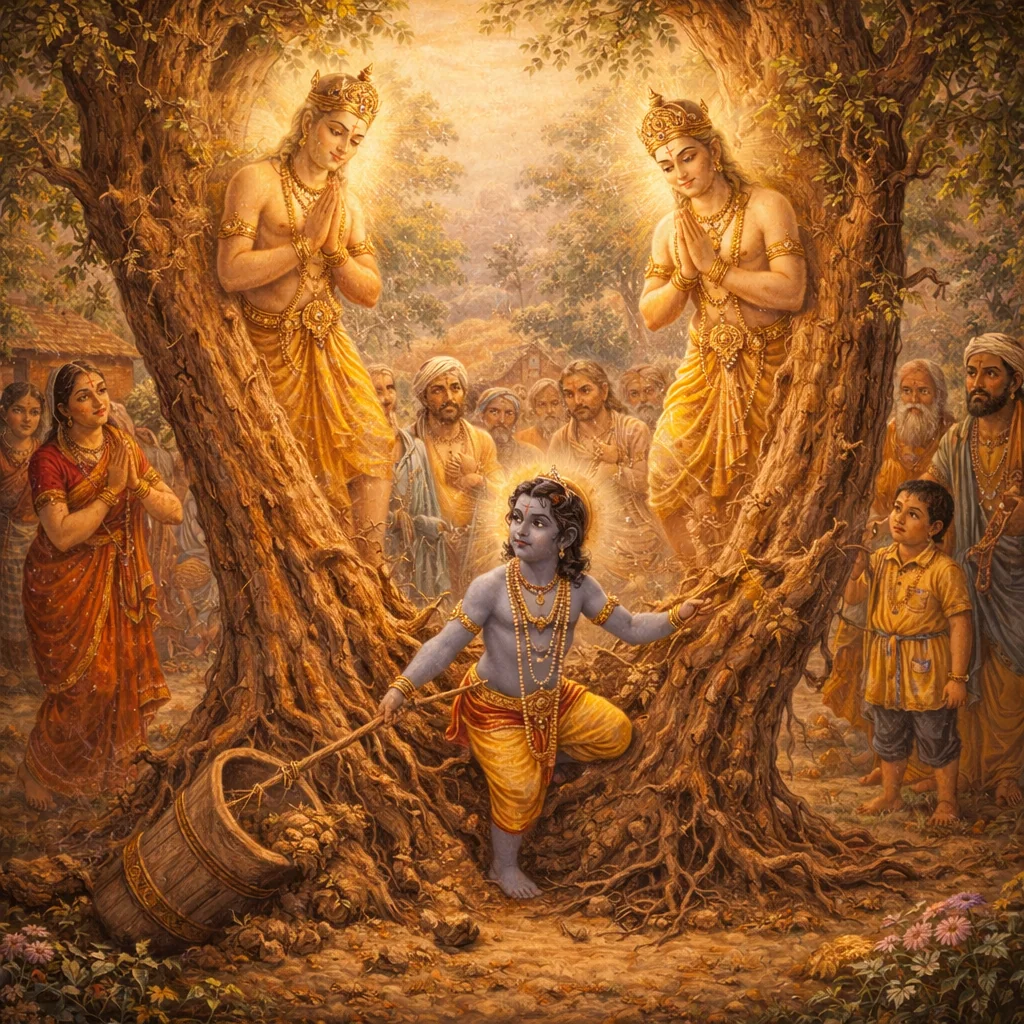
Bound by Mother Yaśodā with ropes of love, child Kṛṣṇa drags the wooden mortar (ulūkhala). When He passes between the two yamala-arjuna trees, the mortar becomes wedged—yet the Lord effortlessly pulls, and both trees crash down. From within emerge Nalakūvara and Maṇigrīva, the two sons of Kuvera, who were previously cursed (by Nārada) to stand as trees. By the Lord’s touch and mercy, they are liberated and offer prayers.
This līlā reveals that Kṛṣṇa is Dāmodara—conquered by bhakti—yet still the Supreme Lord who grants liberation even to the fallen, and teaches the grave danger of pride and intoxication, and the power of saintly association.
"Bound with the rope of His mother’s affection, Lord Kṛṣṇa, known as Dāmodara, pulled the wooden mortar to which He was tied and, passing between the two trees, uprooted them. From them appeared two great personalities, who then offered prayers to the Lord."
— Śrīmad-Bhāgavatam 10.10 Summary
Śāstra‑pramāṇa (scriptural proof)
ŚB 10.10 — Nalakūvara and Maṇigrīva’s fall and Nārada’s curse
The two sons of Kuvera, Nalakūvara and Maṇigrīva, were cursed by Nārada Muni to become twin arjuna trees until delivered by Lord Kṛṣṇa.
Reference: Śrīmad-Bhāgavatam, Canto 10, Chapter 10, verses describing their arrogance, curse, and transformation.
ŚB 10.10 — Dāmodara drags the mortar between the trees
"Thus the Supreme Personality of Godhead, who is never subject to the rules and regulations of the material world, moved from His original place, dragging the wooden mortar with the rope that bound His belly. As He pulled the mortar, it stuck between two trees, and by pulling the rope He forcibly brought the trees down."
Śrīmad-Bhāgavatam 10.10.13-14
ŚB 10.10 — The two are freed and offer prayers
"When the two trees fell down, two great, perfect beings came out of them, illuminating all directions. They offered prayers to the Supreme Lord and, having received His permission, departed for their own abode."
Śrīmad-Bhāgavatam 10.10.20-21
ŚB 10.9 — Connection to Dāmodara-līlā
The pastime is also described in connection with Dāmodara-līlā (ŚB 10.9), where Mother Yaśodā binds Kṛṣṇa, setting the stage for the liberation of the twin trees.
Śrīmad-Bhāgavatam, Canto 10, Chapter 9
Tattva (what this lila teaches)
Bhakti binds the Supreme: Kṛṣṇa becomes Dāmodara—“bound” by His devotee’s love.
Mercy beyond qualification: Even the fallen can be redeemed when touched by the Lord’s mercy and saintly instruction.
Pride is a spiritual danger: The episode warns against arrogance and intoxication; humility protects devotion.
Sādhu-saṅga transforms destiny: Nārada’s intervention ultimately becomes the doorway to liberation and bhakti.
Sevā today (simple practice)
1) Chant one focused round
Chant with one intention: “May I become humble and free from pride; may my bhakti be steady.”
2) Before japa (IAST)
oṁ namo bhagavate vāsudevāya
(optional) oṁ dāmodarāya namaḥ
3) One concrete act
Choose one small “bond of love” today—keep a promise, do a quiet service, or restrain one bad habit—and offer the result to Kṛṣṇa.
"The Supreme Lord, though never subject to birth, death or material bondage, accepts bondage by His devotee out of love. Thus He is known as Dāmodara, 'He whose belly is bound by ropes.'"
— Śrīmad-Bhāgavatam Purport
How to use this darśanam page
This page provides a complete śāstra‑mārga contemplation on the Yamalārjuna-bhaṅga līlā. Use it for daily meditation:
View the image → read the narration → study the śāstra pramāṇa → contemplate the tattva → perform the seva.
The structure is fixed to maintain śāstric integrity while allowing deep personal reflection.